
Modern urban planning is no longer just about placing furniture on a mineral slab. The convergence of land use efficiency, climate management, and reversible uses is redefining the grammar of public space projects. We are witnessing a clear shift: local authorities are now choosing between fine-tuning existing structures and creating from scratch, with direct consequences on material selection, the sizing of structures, and the timing of interventions.
Deimpermeabilization and climate comfort: the technical foundation of a current urban project
Any project for the development of a square or street that ignores the management of rainwater at the parcel level is outdated. Deimpermeabilization of soils is the first lever for reducing heat islands, well before decorative greening. Removing a bituminous surface to install a planted draining substrate changes the water balance of the site and lowers the surface temperature by several degrees during heatwaves.
We recommend addressing this aspect from the sketch phase, not during the finishing phase. The choice of a permeable surface instead of traditional asphalt determines the cross-section profile, slopes, and the location of networks. Stabilized limestone, grass-jointed pavers, draining concrete: each solution imposes maintenance and load-bearing constraints that must be integrated into the program.
Renaturation goes beyond adding plant boxes. It involves reconstructing continuities of living soil capable of absorbing regular rainfall without resorting to the combined sewer system. When a local authority wishes to explore the site designenville.fr to find references for projects that combine design and environmental performance, it is precisely this dual requirement that guides the selection.
Modular urban furniture: designing for reversibility
Reversibility has become a full-fledged design criterion. Local authorities are shifting from a logic of fixed large projects to tactical interventions, tested at the neighborhood scale before permanent deployment. This approach radically changes the way furniture is specified.
A bench set in a concrete slab commits the local authority for a decade. A weighted seating module, movable by forklift, allows for reconfiguring a space in a few hours. The unit cost of movable furniture is offset by the flexibility of use and the reduction of roadworks.
Selection criteria for reversible use furniture
- Weight and dimensions compatible with movement by light machinery, without civil engineering intervention
- Materials resistant to freeze-thaw cycles and UV without heavy treatment (corten steel, class 4 wood, powder-coated aluminum)
- Ground fixation by weighting or bolted plate rather than chemical sealing, to allow repositioning without demolition
- Compatibility with multiple configurations: seating, planter, boundary marker, support for temporary signage
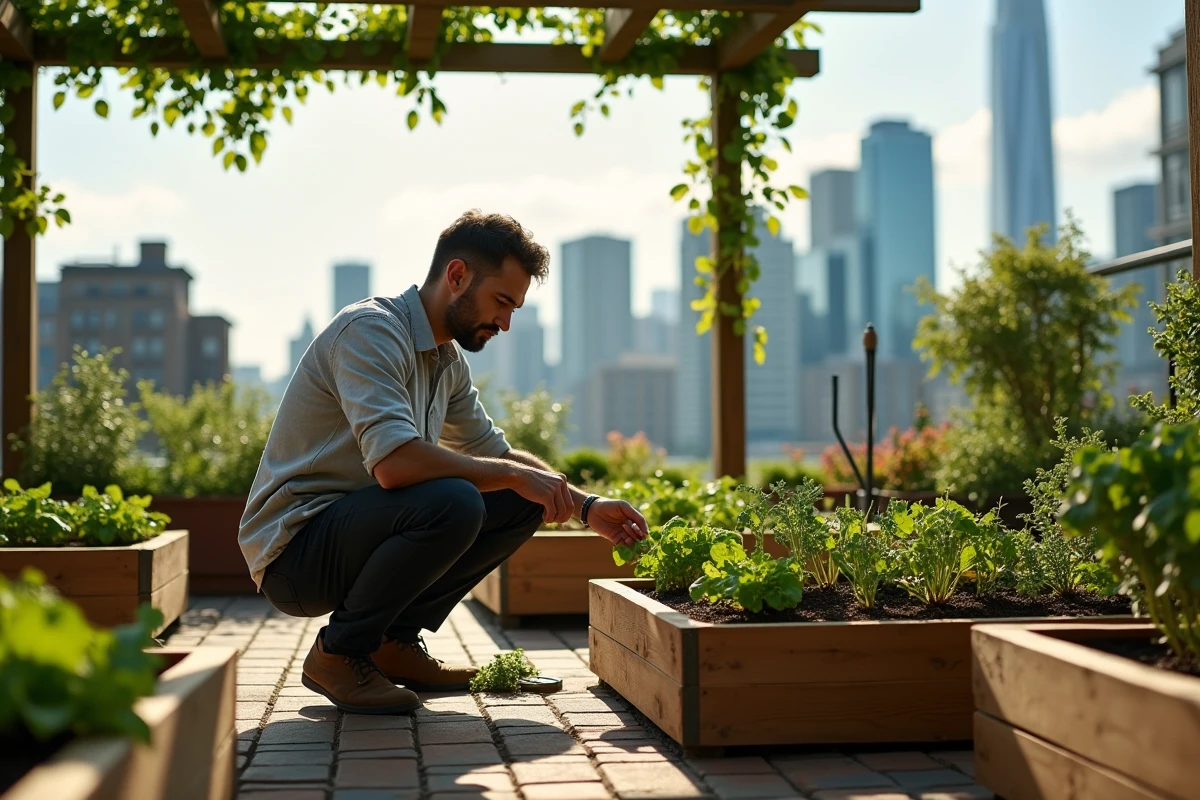
Movable urban gardens illustrate this logic well. Structures on legs or wheels, equipped with substrate and integrated irrigation, allow for greening a mineral square for the duration of a summer, then freeing the space for a winter market.
Biosourced materials and circular economy in urban projects
Wood remains the most commonly used biosourced material in public space development, but its use requires a strict specification. Untreated class 3 wood laid in horizontal decking will not last five years in an exposed urban context. The choice of species (black locust, oak, class 4 treated pine) and profile (non-slip grooved, minimum thickness suitable for rolling loads) determines the project’s durability.
The circular economy is beginning to structure calls for tenders. Reuse of recovered sandstone pavers from roadworks, furniture made from deconstruction steel, recycled concrete curbs: these solutions exist and can be specified in a technical specifications document. Their integration requires active monitoring of local reuse channels and anticipation of supply times, which are often longer than for new materials.
Land use efficiency and transformation of the existing
The trajectory imposed by the Climate and Resilience Law pushes local authorities to transform existing structures rather than expand urban sprawl. In practice, this means requalifying oversized parking lots, converting neglected road spaces, and densifying underutilized commercial fringes.
These transformation operations often cost more per square meter than development on virgin land because they involve selective demolitions, asbestos removal, and adjustments to buried networks. The gain is measured at the territorial scale: no new artificialization, maintenance of peripheral biodiversity, reduction of service costs.
Public space design: balancing aesthetics and performance
A creative urban development project cannot sacrifice technical performance for aesthetics. We regularly observe redesigned squares with visually appealing materials in 3D renderings but disastrous in use: glaring light-colored slabs in summer, metal seating burning hot in the sun, plants unsuitable for the local microclimate.
High-performance design integrates thermal constraints from the choice of colors and textures. A palette of light colors for horizontal surfaces reduces solar absorption. Vertical elements (pergolas, shade structures, tall trees) create shade over seating areas without resorting to mechanical devices.
- Favor colors with high albedo for floor coverings exposed to direct sunlight
- Position seating under plant cover or shade structures, never in full southern sun without protection
- Select tree species with spreading canopies and deciduous foliage to maximize summer shade while allowing winter light
Modern city planning plays out in these concrete trade-offs. A successful public space is one that users occupy spontaneously, not one that wins a design award on paper. The quality of a project is verified a year after delivery, when residents choose to settle there rather than by default.