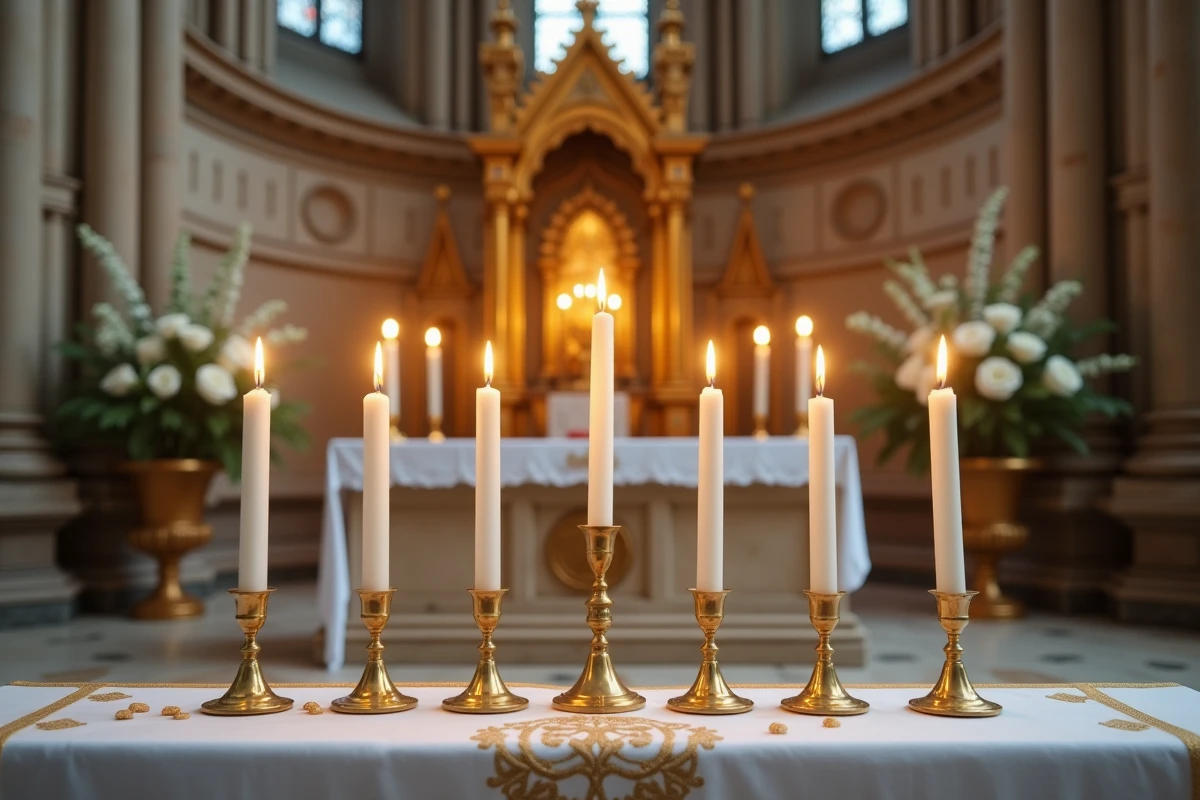
Six flames aligned on a Catholic wedding altar, three on each side of the cross. This precise arrangement is not merely a decorative choice. It adheres to liturgical prescriptions that have been codified for centuries, intertwining theology, institutional history, and ceremonial practice.
The number of candles lit on the altar during a religious wedding depends on the type of celebration and the rank of the celebrant, according to rules framed by canon law and the rubrics of the Roman Missal, often overlooked by the engaged couples.
The liturgical rank of the celebration determines the number of candles on the altar
Most articles on the subject present the six candles as a fixed spiritual symbol. The liturgical reality is more technical. The number of lit candles primarily depends on the degree of solemnity of the Mass.
A priest celebrating an ordinary Mass lights two candles. For a solemn Mass, it increases to six. When a bishop presides over the celebration, a seventh candle is added at the center, referencing the menorah, the seven-branched candlestick of the Temple of Jerusalem, a symbol of fullness. Therefore, a religious wedding, celebrated as a solemn Mass, naturally calls for the configuration of six candles.
To delve deeper into the significance of the candles on Univers Mariage, one must refer back to the rubrics of the Roman Missal, which have codified this practice since the Council of Trent in the 16th century.
This distinction between two, six, or seven candles is not anecdotal. It signals to the attending faithful the exact rank of the celebration even before the priest utters a word. The candles function as a visual language of the liturgy.
Roman rite and Tridentine rite: two frameworks, the same number of candles
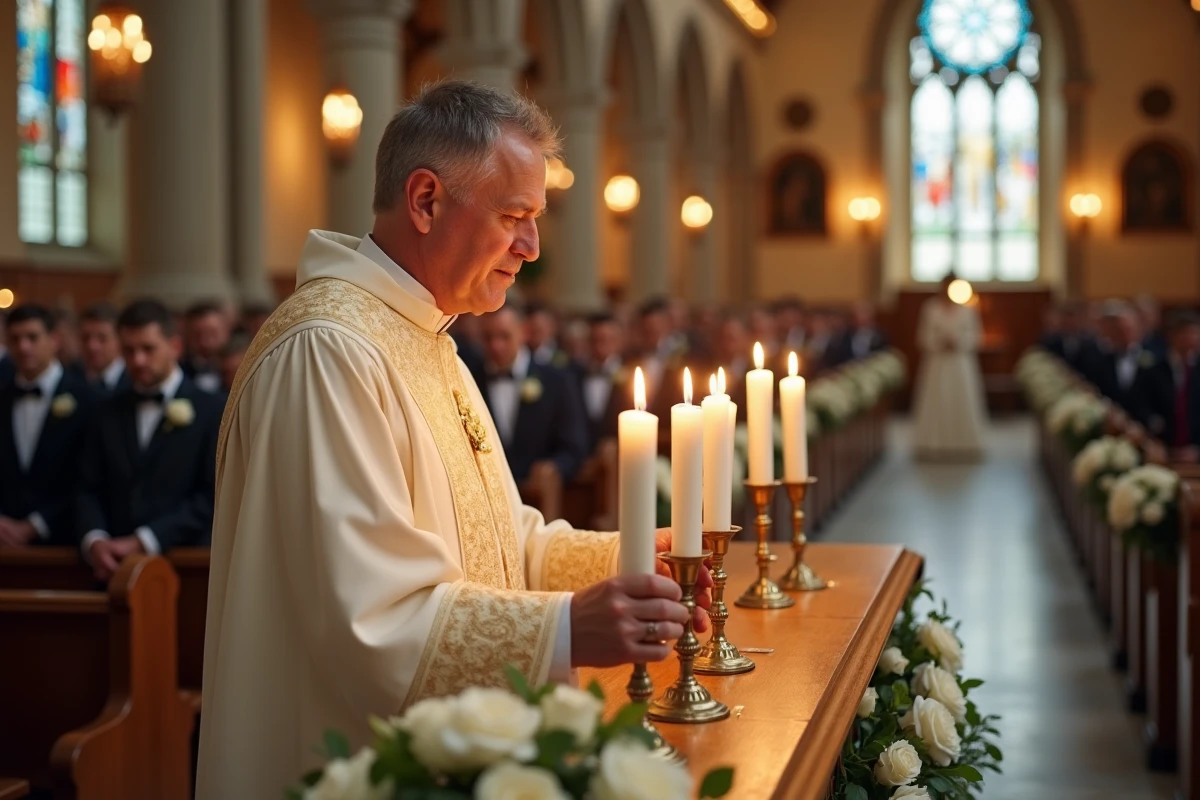
Since the liturgical reform stemming from the Second Vatican Council, the ordinary Roman rite has simplified many ceremonial aspects. The six candles on the altar are among the elements that have passed through this reform without major modification.
In the Tridentine rite (extraordinary form, according to the 1962 Missal), the six candles are mandatory for any solemn Mass. Since the promulgation of Traditionis custodes in 2021 by Pope Francis, confirmed by clarifications in 2023, the parishes authorized to celebrate according to this Missal are becoming rarer. Weddings celebrated in this form remain possible but are subject to the authorization of the diocesan bishop.
In the ordinary rite, the General Instruction of the Roman Missal (GIRM) recommends six candles for solemn celebrations while allowing some flexibility for local episcopal conferences. In practice, the vast majority of Catholic weddings in France follow this configuration.
What Eastern rites do differently
The specificity of the number six is unique to the Roman rite. In Byzantine rites, such as the Melkite rite, weddings often use eight candles, referencing the Beatitudes. This divergence illustrates that the number of candles does not hold universal dogmatic value: it pertains to the tradition specific to each rite within Catholicism.
The theological symbolism of the six candles during a Catholic wedding
Three symbolic readings coexist in the Roman tradition, with none being officially privileged by the magisterium.
- The six days of Creation according to the book of Genesis. The candles remind us that marriage is understood as an extension of God’s creative act, with the spouses participating in this mission by founding a family.
- The light of Christ carried by the Church on a mission. Each candle represents an aspect of this light spread throughout the world, and marriage is considered one of the places where this mission is concretely embodied.
- An echo of the six sacraments that accompany the life of the baptized (baptism, confirmation, Eucharist, penance, anointing of the sick, order), with marriage being the seventh, celebrated at the center of this light.
These interpretations do not mutually exclude each other. They overlap in Catholic liturgical theology, where each material element of the celebration carries multiple layers of meaning.
Wax, flame, and wick: a materiality that matters in liturgy
The physical composition of the candles is not left to chance. The liturgical rubrics specify that altar candles must be made of beeswax, at least for their main part. This requirement has a symbolic significance: beeswax, produced by an insect considered pure in Christian tradition, represents the body of Christ. The wick symbolizes His soul, and the flame His divinity.
This material triptych transforms each candle into a miniature representation of the presence of Christ on the altar. During a wedding, this symbolism takes on particular resonance: the spouses exchange their consent in the presence of this light that represents the divine.
In practice, many parishes today use candles with varying proportions of beeswax. Liturgical purists regret this, but no canonical sanction applies on this point.
An evolving practice in French parishes
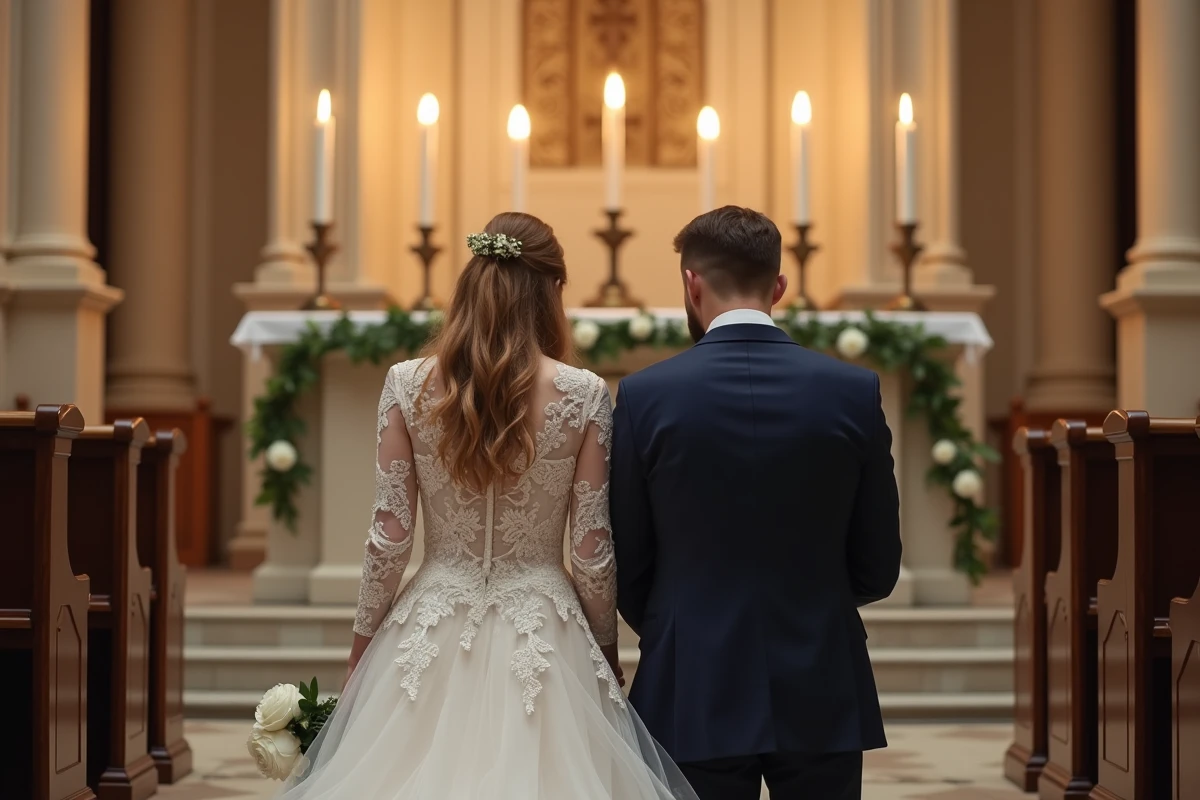
During the Synod on Synodality (2023-2024), several French dioceses documented a recent trend: the spouses light the six candles themselves to symbolize their missionary mission within the Church. This practice, encouraged to strengthen lay engagement, modifies the traditional gesture where only the altar server or sacristan would light them.
Feedback from the field varies on this point. Some priests see it as a pastoral enrichment that helps couples understand the meaning of each gesture. Others believe that this adaptation blurs the distinction between the roles of ordained ministers and those of the faithful in the liturgy.
This tension reflects a broader debate within the Catholic Church about the balance between fidelity to the rubrics and pastoral adaptation. The six candles, however, remain invariant: the number does not change, even when the method of lighting them evolves.
The Catholic religious wedding remains one of the few occasions where people distanced from regular practice discover these liturgical codes. The six candles on the altar, far from being a decorative detail, condense centuries of theological reflection on light, divine presence, and the meaning of the sacrament. Their persistence through successive reforms testifies to the strength of this symbol in the Roman tradition.