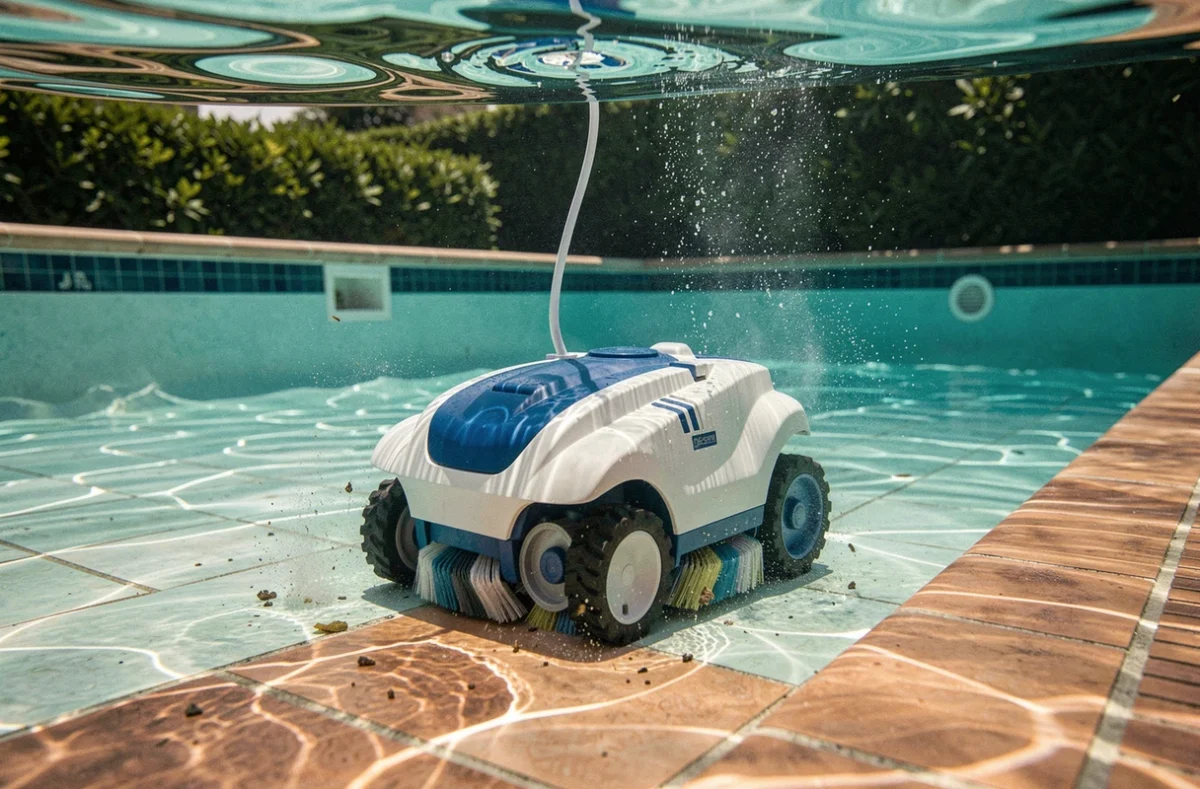
A cordless pool robot advertised as offering 120 minutes of runtime may take more than ten hours, including recharging, to leave a 40 m² pool truly clean. That’s the finding from a test of the Ecovacs Ultramarine P1 published by 01net in November 2026.
Suction power and the area covered per cycle aren’t enough to evaluate a robot: total cleaning time, mid-cycle handling and battery durability all weigh just as heavily on the final result.
Actual cleaning time for a cordless pool robot: advertised runtime versus a complete cycle
Product specifications list runtime in minutes. This figure refers to continuous operation on a single charge, generally measured in floor-only mode, without the demands of complex navigation. Once you switch to a floor, walls and waterline cycle, power consumption increases and the robot may stop before finishing.
01net’s test of the Ultramarine P1 illustrates this gap. In a 40 m² pool, the robot had to be taken out of the water, recharged and restarted to complete its full cycle. Total time: around ten hours, including recharging. Anyone who starts cleaning in the morning won’t find their pool clean until the end of the day.
This kind of scenario doesn’t appear in standard comparisons, which focus solely on comparing runtimes. We believe that total time, including recharging, is the only reliable indicator for comparing cordless robots. A model with a more modest battery but an efficient navigation algorithm may clean a pool in a single cycle, while a more powerful competitor may need two.
A detailed report on the real-world performance of recent models is available on the Jardinier.net website, with coverage and suction-power measurements by category.
Fine filtration in pool robots: the micron-rating trap
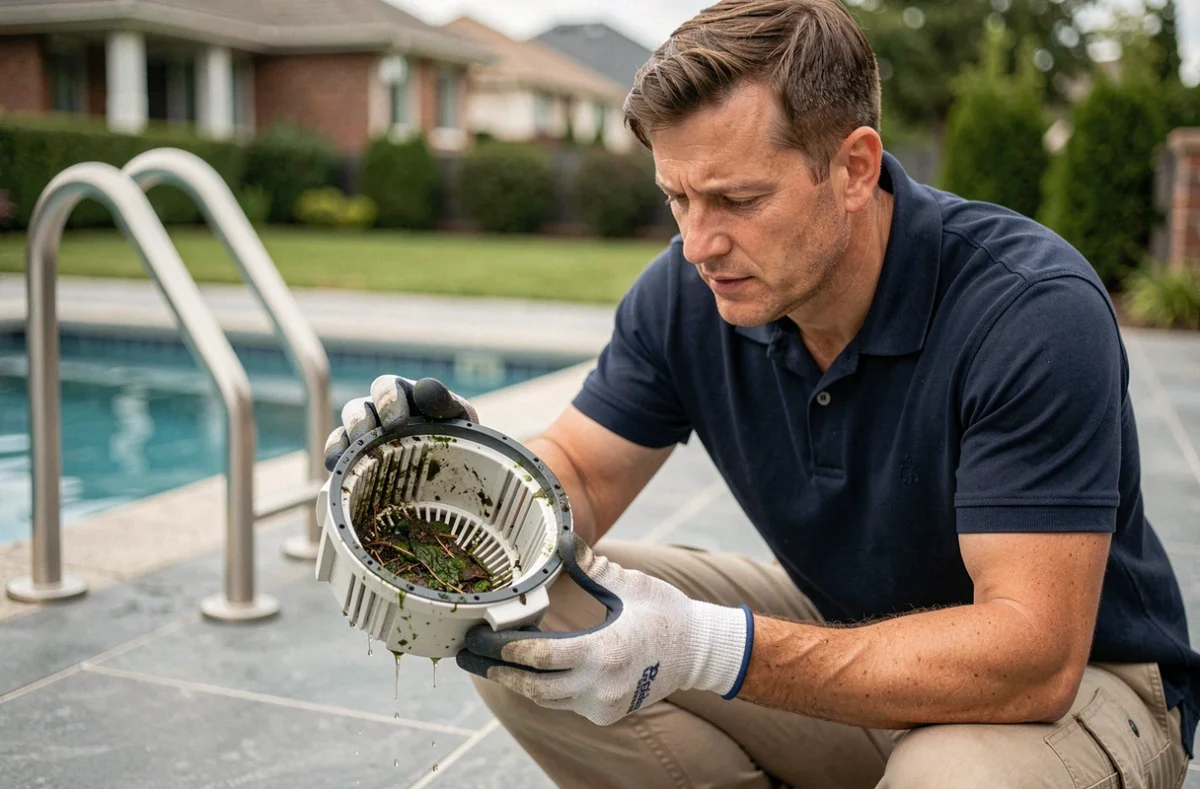
A 3-micron filter captures particles invisible to the naked eye. On paper, that’s a compelling selling point. In practice, finer filtration involves a trade-off that manufacturers don’t emphasize.
A very fine filter clogs more quickly when a pool is full of debris (leaves, insects, sand). Suction flow drops, actual coverage decreases, and the robot may run for a long time without delivering convincing results. 01net highlights this distinction in its test: effectiveness varies considerably depending on the mode used and the filter installed.
A fine filter performs well only in a pool that’s already partly clean. After a week away or a storm, an initial pass with a coarse-mesh filter is often still needed before switching to fine filtration. Models supplied with two cartridges (coarse and fine) offer this flexibility, but users have to intervene manually between passes.
Three filtration criteria to check before buying:
- The number of cartridges included and their respective micron ratings, since a single fine filter may need rinsing mid-cycle in a debris-heavy pool
- The capacity of the filter basket, which determines how much debris the robot can collect before suction starts to drop
- How easy it is to rinse: some models, such as the Dolphin E20, open from the top, while others require partial disassembly
Actual pool coverage: why the advertised square footage can be misleading
The maximum area listed on the packaging assumes a rectangular pool with no steps, submerged ledges or gentle slopes. As soon as the layout gets more complicated, coverage drops.
User reviews of the Gosvor LiteVac 800-GS on Amazon mention repetitive paths, difficulty picking up fine particles and disputed claims about the area actually cleaned. These reviews aren’t a substitute for laboratory testing, but they point to a recurring issue: navigation determines coverage just as much as suction power does.
Navigation technologies fall into three categories, with very different results:
- Random navigation: the robot bounces from obstacle to obstacle. Coverage is acceptable in a small rectangular pool, but patchy in an L-shaped pool or one with corners and recesses
- Gyroscope-based navigation: the robot follows parallel paths. Coverage is better, but it may miss areas near the coping or steps
- Mapping-based navigation (camera or sensors): the robot creates a map of the pool and optimizes its route. This is the only system that can cover a complex pool in the fewest passes
A robot advertised for a large area but equipped with random navigation will leave parts of a medium-sized pool uncleaned if its layout is irregular. A mapping-based model with a more modest advertised coverage area is a better choice.
Replacing a pool robot battery: a regulatory factor to plan for
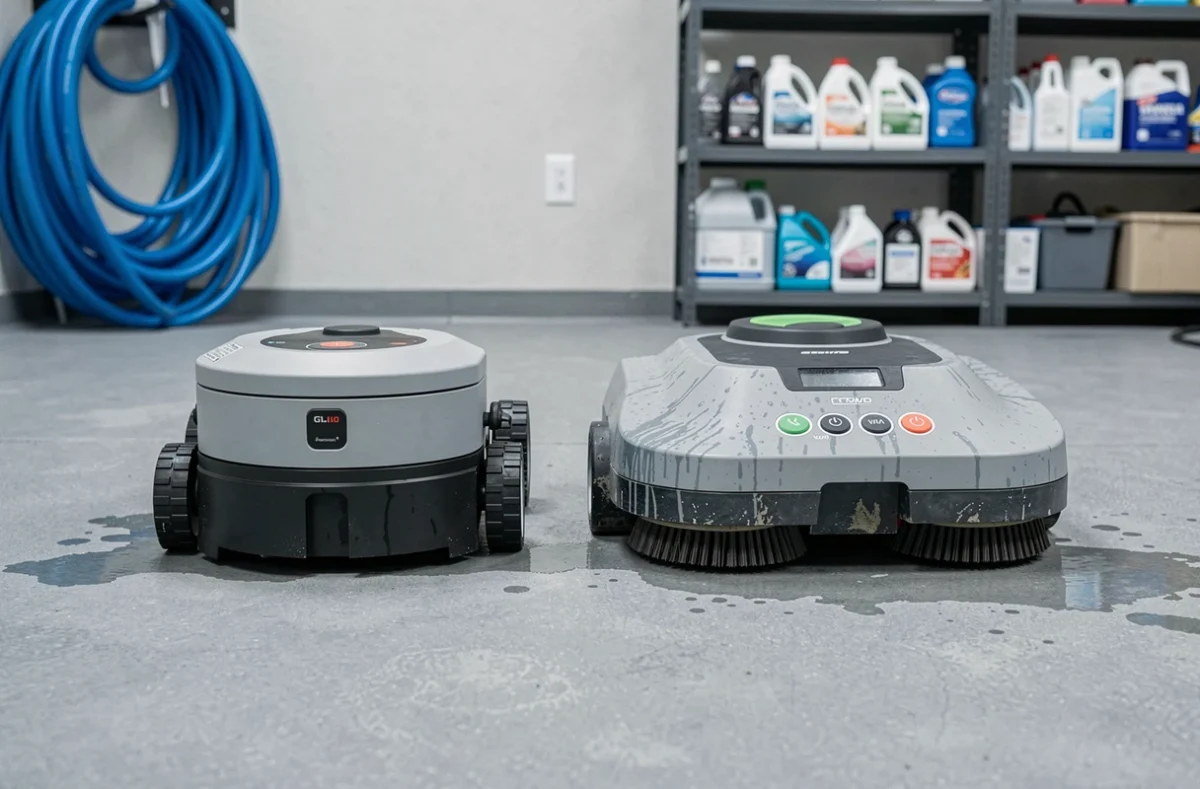
The lithium-ion battery in a cordless robot loses capacity after a few hundred charge cycles. It’s a wear part, not an optional accessory. The cost and feasibility of replacing it determine the appliance’s actual lifespan.
Article 11 of the European Batteries Regulation applies from February 18, 2027. This legislation sets out repairability and battery-replacement requirements for many portable devices. Pool robots, which are designed to operate underwater, may qualify for exemptions, but the broader framework is pushing manufacturers to make batteries easier to access.
Before that date, the situation varies. Some manufacturers sell replacement batteries as spare parts for a few dozen euros. Others require the robot to be sent to a service center, sometimes at a cost close to one-third of its purchase price. Checking the battery’s availability, part number and price before buying can help avoid an unpleasant surprise after two or three seasons.
A corded robot powered by a low-voltage transformer doesn’t have this issue. For a heavily used pool, the cable offers a tangible advantage in terms of longevity, despite the handling involved. Choosing between corded and cordless isn’t just about convenience: it also affects the cost of ownership over five to ten years.